

Riding the Oil and Natural-Gas Boom
Thursday, June 30, 2011
By Carol Wasson
The truck, trailer, and transport industry is on a natural high, serving a frenzy of well site construction needs in a round-the-clock construction boom that includes the installation of roads, well pads, and pipelines, which means that every contractor must get the right equipment to the right job site at the right time. The boom began with improved hydraulic fracturing technologies that make it possible to produce oil and natural gas in places where conventional methods are ineffective. It uses water pressure, under tight controls, to create fractures in rock that allow the oil and natural gas it contains to escape and flow out of a well. Until recently, formations such as the Marcellus shale in Pennsylvania; and the Fayetteville shale in Arkansas, were not considered profitable for gas production. But this new “fracking” technology, combined with a dire need for additional domestic energy sources, has dramatically altered the playing field.
Truck and Trailer Trips per Multiwell Pad
The Department of Environmental Conservation (DEC) estimates a staggering number of truck trips required to bring in rigging, equipment, water, and materials for the multiwell pads under construction in the Marcellus Shale formation, for example.
 |
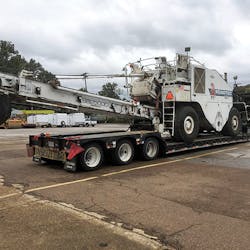
Photo: Rogers Brothers Corp.
The Rogers OF40L features heavy-duty main beams and side channels. |
DEC data indicates that truck trips per multiwell pad (assuming two rig and equipment deliveries and eight wells) are:
- Drill pad and road construction equipment: 10–45 truckloads
- Drilling rig: 60 truckloads
- Drilling fluid and materials: 200–400 truckloads
- Drilling equipment (casing, etc): 200–400 truckloads
- Completion rig: 30 truckloads
- Completion fluids and materials: 80–160 truckloads
- Completion equipment (pipe, wellhead): 10 truckloads
- Hydraulic fracture equipment: 300–400 truckloads
- Hydraulic fracture water: 3,200–4,800 tanker trucks
- Hydraulic fracture sand: 160–200 truckloads
- Flowback water removal: 1,600–2,400 tanker trucks
Engine Performance
Steve Kent Trucking has served the oil and gas industry of Louisiana and South Texas since 1992 with its five regional offices and a fleet of 175 trucks, mostly Kenworths.
“We support fast-paced drilling operations with product hauling, waste hauling, pumping, and handling of just about any liquid in the oil and gas business,” said owner Steve Kent.
When it comes to equipment, Kent says, “Downtime will kill you in this business. That’s why I buy Kenworth T800s with PACCAR MX 485-horsepower engines. What has hurt me in the past has been the serviceability on other engines. Trucks would sit for two, four, even eight weeks waiting on the engine manufacturer to address an issue. I prefer the PACCAR MX engine because the Kenworth dealer can diagnose a problem right away and get me back on the road quickly. I’ve been running PACCAR MX engines a long time. I ran three prototype trucks as part of the PACCAR MX testing program for three years. The engines were flawless.”
Downtime can be especially hard on Kent’s drivers, too, who are assigned a specific truck and work on a percentage of the gross. When equipment fails, revenues stop flowing. That’s why Kent’s drivers say that they appreciate and prefer the long-term durability and dependability of Kenworth trucks. Many drivers actually purchase their Kenworth trucks when Kent gets ready to trade them in. “After five years, I will sell the trucks to my drivers who want to become oil operators, and I’ll finance them myself. My drivers are all self-made business people and we have it set up so they can make plenty of money. My whole deal is keeping my drivers happy. We work 24/7 on these rigs. We might go out to a rig and get hung out there for two or three days. It’s a challenging business,” says Kent.
While every year the challenges seem to multiply, Kent and his manager in South Texas, Bobby McConal, are constantly looking for equipment that can keep pace. “Our newest standard spec going forward is the PACCAR MX engine,” said McConal. “If we have an engine issue, we want it solved at the dealership. That way, at all our service points, we don’t have to wait on another engine manufacturer to make a decision. We want one standard engine that we can depend on in the field and at our Kenworth dealer.”
Reliability on Rough Haul Roads
Satterfield Pipeline, of Norfork, AR, is a contractor whose specialty is laying field gathering lines that connect with larger natural gas pipelines. The projects involve clearing, grading, stringing pipe, and trenching—with each task requiring a separate crew and at least three to five pieces of equipment onsite. Until just several years ago, the company had outsourced its hauling and did not own its own trailers. Today, the company relies daily, or even hourly, upon two Talbert customized haul trailers to transport its Komatsu excavators (55,000- to 80,000-pound units) and dozers from site to site.
“When we outsourced our hauling, we often had to wait a day or two to get equipment onsite. Now, when we get a call, they want you onsite in the next hour. These days, if you don’t get there immediately—someone else will,” says Mark Satterfield, co-owner of the company along with his father, Loyd, who founded the business as an earthwork contractor in 1972.
Currently, Satterfield Pipeline operates two different trailer models from Talbert Manufacturing—a 50SA and a 55SA, both featuring a non-ground-bearing hydraulic gooseneck design. “It takes a well-built trailer to hold up in the oil-and-gas industry. We’re not running on the interstate, but rather on rough haul roads. To get to the wells, we may run on gravel roads for 10 miles at a time to get to a job site,” says Satterfield.
The Talbert 50SA offers a low-profile design and a framework that’s reinforced for a future fourth axle. Offering an advantage in load capacity over comparable models, says the company, the Talbert 50SA is rated at 100,000-pounds capacity in a 12-foot, 6-inch load base. Rated at 110,000-pounds capacity, the Talbert 55SA features the flexibility of a three-plus-one axle configuration or a fourth axle pin-on.
According to Talbert engineers, both the Talbert 50SA and the Talbert 55SA deliver greater lifting capacity, over comparable models, due to the number of hydraulic cylinders. While most conventional trailers feature only two cylinders, Talbert trailers are engineered with four hydraulic cylinders. This key differentiator means that Talbert trailers offer a lifting capacity that minimizes and/or eliminates the need for the frequent load adjustments typically required when operating a two-cylinder trailer. Additionally, Talbert strategically places its cylinders further from the trailer’s fulcrum point, allowing greater vertical travel in the deck.
The Talbert trailers are customized to fit Satterfield’s requirements. “I can airlift the back axle on my 55-ton trailer. It’s also got the excavator cut-outs so that I can get my booms lower and am not over height regulations. Additionally, it has extra D-rings, and I have pony motors on each trailer that run the hydraulics. So just in case a truck goes down, I can easily hook the trailer up to another truck,” he says.
For Satterfield, “gathering gas” is an entirely different ballgame than that of merely laying pipeline, as they had done in years prior. In this market, he says, you get no notice. “You get a call and you need to be there. Every minute that the customer is not selling gas is money lost.”
A Fleet Built for North America
Serving 10 Canadian provinces as well as 48 states, Bushell Transport is a heavy-equipment hauler in the oil-and-gas, construction, road-building, and pipeline industries. “We are very proud to run Murray trailers, as they are the strongest and lightest trailers on the market,” says Grant Glattacker, president and chief executive officer of Bushell Transport. The company has Murray low-profile 48-foot double drops as well as Murray 16 wheelers. “Their 16-wheel design is legal in Alberta, and Murray modified that design for us by adding a third axle, which allows us to pack a lot of weight across borders—and utilize the same trailer on both sides of the border,” he says.
Glattacker says that these trailers serve a target market in the 60,000- to 80,000-pound weight class, which covers a large majority of the oversize weight category. “Due to this equipment, we are one of the few carriers in North America who can haul in this market across borders,” he says. “These trailers have very low rear profiles for hauling service rigs, wire line, and construction equipment that most carriers would need to do on a stretch double drop—and we can pack more weight and size and be more cost effective than a stretch double drop in most cases. In the event that a stretch double drop is required, we can offer that as well up to 10 axles. We also run California 9-axles with wheeler jeeps, which allows for greater payloads—and Murray trailers keep our tare weights down so our payloads can go up,” he adds.
The Bushell truck fleet is entirely Peterbilt. “The oldest Peterbilt model is 2006 and the newest is 2011. Each of our trucks is equipped with Shaw Satellite Trucking/Scanning, which is fully integrated with our Sylectus dispatch system. Also, we are the first carrier in Canada to offer the BOSE ride seat in our heavy haul trucks. It’s an amazing piece of technology that makes time on the road far more enjoyable for our expert drivers,” he says.
Extended Hauling Solutions for Oil Transportation
XL Specialized Trailers Inc. offers two models engineered with the oil industry’s needs in mind—the XL Step Deck Extendable and the XL Folding Gooseneck. According to XL, the field tail roller and pipe pocket options in both models are especially useful to customers in the oil, gas, and pipeline industries. Ideal for easy loading, XL’s Step Deck Extendable features many different rollers, including neck rollers, tail rollers, and pop-up rollers.
Shawn Barney is a salesman for Wallworks, an XL authorized dealer in North Dakota. He lists many uses for the Step Deck Extendable. “It’s really great for longer loads,” he says. “It works for anything from skid shacks, sump pumps, shakers, gensets, and mud pumps, to tanks. The pop-up rollers make for easy usage.”
The Step Deck Expendable also features the Extend-a-Track, which allows users to extend and retract the trailer without hooking and unhooking the air and electrical lines. The air-operated lock-pin system in the Step Deck stops where needed.
The XL Folding Gooseneck features a self-contained power unit built into the main deck on a single drop and in the wheel area transition on the double drop.
“The many customization options make the XL Folding Gooseneck extremely versatile. Self-contained units or wet-line-operated units are available for customers. There are also multiple kingpin settings offered in order to achieve proper load distribution with almost any tractor or truck. The winch can be placed in the wheel area to load inoperable equipment. As with all XL products, customers can customize their order to fit their specific needs,” says Barney. “Working with Joel Dewey (XL factory representative) and the engineers at XL to customize the trailers allows me to use the feedback from my customers and make adjustments,” he says.
Trailer Product Highlights
Rogers Brothers Corp. offers its Oil Field OF40L—a 40-ton capacity trailer, which features a rear tail roller and a spacious 35-foot level deck, and is designed to handle the workhorse duties needed in oil and natural-gas exploration, says the company. The unit features heavy-duty main beams and side channels with deep cross members that combine to make a strong and durable trailer frame. Its undercarriage includes flip-leg landing gear and single-point, two-spring suspension. Both axles have spring parking brakes and a premium 4S/2M antilock braking system. Also, the Rogers OF40L trailer has a rounded front designed with an attachment for winch lifting. It has a pair of recessed air-line glad hands that are retractable for the easy removal of dirt and mud.
Palomino Manufacturing Corp. offers its Muv-All Trailer Series, which is highly suitable for use in construction equipment transport for well site preparation. The series includes both single-drop and double-drop low-bed trailers and both mechanical and hydraulic detachable gooseneck trailers. According to Palomino, all Muv-All Trailers feature HSLA steel beams that are more forgiving under load, and are easy to service; 1.5-inch-diameter tail hinges that are beefed up (by 50%) for tougher, more reliable operation; pre-arced beams and custom-designed crossbars for greater beam life; optional double-screw fastened wood floors sealed all around for extended floor life; and a structurally integrated standard steel floor that prevents floor bending between crossbars.
The Trail-Eze 2011 TE100DGLP is designed with 13-inch beams and I-beam style cross-members, and offers a 20-inch deck height with a 7-inch ground clearance. The main deck is 102-inches wide by 24-feet long with an extended rear slope. The Trail-Eze TE100DGLP is the ideal trailer for the excavation contractor or construction equipment hauler. The entire deck is covered with either oak or apitong. According to the company, its ease of loading, flexibility and customer- driven design makes this Trail-Eze unit highly suitable for the oil and gas market.
Towmaster Trailers offers its Titanium Model Series, of which its T-110DTG is most suited to the heavy equipment transport needs of the oil and gas industry, says the company. This triple-axle unit offers an 110,000-pound load capacity; a 24-inch (fully) loaded deck height; an 11-foot, 10-inch gooseneck; 96-inch swing clearance; and a 24-foot main deck. Towmaster says it uses only the best-grade T1 steel in the manufacturing process. The T1 is fabricated into cambered main beams to give the Titanium Series trailer its light-weight strength.
 |
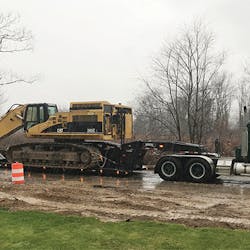
| Photo: Dragon Products |
A Game-Changing Resource
Currently, Pennsylvania, West Virginia, Louisiana, Texas, Arkansas, and other states are reaping the economic benefits of a natural-gas boom. A Penn State University study predicted that the natural gas industry in Pennsylvania alone will be responsible for the creation of 111,000 jobs and for bringing in an additional $987 million in tax revenue to the state by the end of 2011. Natural-gas extraction has been one of few industries growing (without government subsidies) during this recession, offering an unmatched opportunity—and a natural high—to many entrepreneurs in heavy equipment hauling and truck and trailer manufacturing.
Fontaine Magnitude 55MX
Fontaine Trailer is introducing a heavy-haul trailer that handles a wide variety of hauling jobs.
The Fontaine Magnitude 55MX extendable heavy-haul trailer features a modular design that provides exceptional convenience and versatility. Fabricated with 100,000-pound minimum yield steel flanges, the Magnitude 55MX has a 29-foot clear deck length in the retracted position and easily extends to 50 feet.
The loaded deck height is 20 inches with 6 inches of ground clearance. It handles up to 55 tons in frame capacity in as little as 16 feet. Features include
- a versatile gooseneck with all the connections needed to add the optional flip box to achieve 125-inch swing clearance;
- an adjustable locking ride-height mechanism to match the deck-to-fifth-wheel relationship;
- a ramped bogie, featuring a modular connection to match equipment needs;
- built-in tool box and storage compartments.
According to John Craig, president of Fontaine Trailer Co., “If you haul a variety of equipment, then the modular design lets you switch easily and quickly to accommodate just about any
hauling job.”
Author's Bio: Construction writer Carol Wasson is a frequent contributor to Forester publications. |
Advertisement]