









The Grading and Excavation Contractor Blogs

The Blogger

Trotti, John

More from this blogger

Grading and Excavation Contractor Editor's Blog

  • RSS
  • Save
  • Print
  • Email
Monday, August 03, 2009 8:00 PM

Y2K Plus Ten

By: Trotti, John Comments

It seems like only yesterday that we were worried about what computer monsters lay hidden in the transition to the new milennium…worries fed by guys in suede shoes for the most part, but the magic date came and went with fewer ripples than when an F-22 Raptor slips into supersonic flight. That was a decade ago—a time many of us scoffed at the idea that joysticks and computers would replace levers and mechanical linkages or that we would find ourselves relying more and more on space-age wizardry to do jobs that only a lifetime of experience would allow us to approach with total confidence.

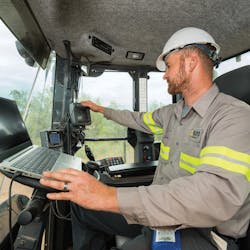
Today, however, we watch as relative neophytes climb aboard modern machines, fire up, check information relayed to a video display, adjust the volume on the tape deck, and then trundle off to do a day’s work with speed and precision heretofore the province of the “old pros.” Does this mean an end to the need for excellence? No way, but it does open up some exciting possibilities.

In an industry certainly more noted for its conservatism than for its forays into the ragged edge of the technological envelope, you have to wonder what got into the equipment designers’ Thermos bottles as the last century drew to a close and when all of this change will slow down and allow us to catch up. I suggest not holding your breath.

The moment the equipment manufacturers dipped into their grab bag of tricks and emerged with digital replacements for their timeworn, analog mechanical systems, we crossed a magical threshold and stepped into a realm of incredible—I’m tempted to say infinite—possibilities bound only by our ties to the past.

Ponder this if you will: The astronauts who went to and walked on the moon did so with orders of magnitude with less computing power than we carry in our cell phones. Until three decades ago, the ability to determine your location in three-dimensional space was a laborious process that could take hours, and even when global positioning system (GPS) units became available to the public, another decade passed before the government stopped dithering the signal and allowed us access to really useful levels of precision. Today you can go down to your local shopping center and buy a computer, software, and peripheral equipment that would rival the best on the planet when the Berlin Wall came down, and you have in the bare bones of your grader, excavator, dozer, or loader more intelligence than the Boeing 747 had when it came into service.

What Do You Want To Do Today?
How about seeing not only where you are but also where you plan to be when the job is done? Watch any TV show on modern fighter aircraft and see what magic resides in the systems at the pilot’s fingertips and in some cases even beyond his conscious control. Look at the wealth of information available for call-up on a multifunction display or even on the aircraft's windscreen or canopy. While the aircraft is waffling around in the dark of night or plunging through fog and clouds, sensors of various kinds are able to acquire detailed images in near-daylight clarity and display them in any of several ways that allow the pilot to perform the mission with confidence and precision. If this isn’t enough, the pilot can access data from the aircraft’s radar or threat-warning sensors and project them as overlays to visually enhanced imagery to aid in the solution of complex tactical problems. Do these capabilities seem too far-fetched for dirtmoving activities? They’re not. In fact, they are very much within the capabilities of equipment and technologies in use right now.

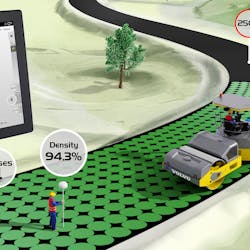
An increasing number of operators are making use of laser and GPS to guide or actually control blades, buckets, or the movement of entire machines, and typically these actions or guidance cues are displayed symbolically on a dash-panel monitor. That’s pretty neat, but the same information could be placed on the windshield, presenting the operator with a superimposed view of where to go and what to do to achieve whatever the plan calls for. How much more difficult is it to imagine the potential advantages of adding video or infrared imagery to aid operators in confined or low-visibility situations?

Most of us gulp at the thought of remote-control equipment running around a job site, but do you doubt that this is possible and in certain applications desirable if not downright necessary? Already we see this happening in farming operations where tractors grind their way over hundreds or even thousands of acres under GPS control, making furrows or laying down seed. Closer to our activities are a variety of remote-control robots used to work with dangerous materials or in lethally contaminated areas, so how much sense does it make for us to put operators at even a slight risk by having them work in contaminated soils when we have the ability to accomplish these tasks remotely or even robotically?

What Do You Think?


Be the first to tell us what you think!

Post a Comment

Note from the Editor: The content that appears in our "Comments" section is supplied to us by outside, third-party readers, and organizations and does not necessarily reflect the view of our staff or Forester Media—in fact, we may not agree with it—and we do not endorse, warrant, or otherwise take responsibility for any content supplied by third parties that appear on our website. All comments are subject to approval.

CAPTCHA Validation
CAPTCHA
Code:


Grading and Excavation Contractor Email Updates!

Get weekly news and updates through our email newsletter!